- Home
- Company
- Products
- News
- FAQs
- Blog
- Contact
Leave Your Message
Global buyers are examining 48V 300Ah lithium-ion batteries as energy costs rise and electrification expands. The International Energy Agency reported that global battery demand for electric vehicles exceeded 750 GWh in 2023. Stationary storage demand also grew strongly, reaching about 130 GWh. These figures show why large-format batteries now attract attention beyond passenger vehicles.
A 48V 300Ah battery stores approximately 14.4 kWh under nominal conditions. That capacity can support solar backup, electric utility vehicles, marine equipment, and off-grid systems. However, rated energy is only the beginning. Buyers should verify usable capacity, continuous current, peak current, cycle-life testing, thermal protection, and battery-management-system records. Installation conditions matter too. A battery operating in a hot equipment room may age faster than one with controlled ventilation.
The phrase “48 Vot 300 Amp Lithium Li-Ion” appears in some purchasing searches, although the wording is technically imperfect. Product names can mislead. A reliable comparison should examine cell chemistry, commonly LiFePO4 for safer stationary applications, enclosure protection, transport documentation, warranty terms, and after-sales support. The Global Battery Alliance and UL Solutions both emphasize traceability, safety evaluation, and responsible battery practices across the supply chain. Yet no single certification proves that every battery suits every project. That is worth remembering.
This guide compares practical specifications, supplier credibility, regional compliance expectations, and total ownership cost. It also questions optimistic cycle-life claims. Real performance depends on temperature, charging habits, depth of discharge, and maintenance. For global buyers, the best 48V 300Ah lithium-ion battery is not simply the largest or cheapest option. It is the one whose tested performance matches the application, installation environment, and long-term service plan.
Best 48V 300Ah Lithium Ion Battery for Global Buyers?
What Is a 48V 300Ah Lithium-Ion Battery?
A 48V 300Ah lithium-ion battery stores about 14.4 kilowatt-hours of nominal energy. The calculation is simple: 48 volts multiplied by 300 amp-hours. However, usable energy is lower in real installations. The battery management system may reserve capacity to protect the cells. Temperature, discharge rate, battery age, and inverter efficiency also reduce available power.
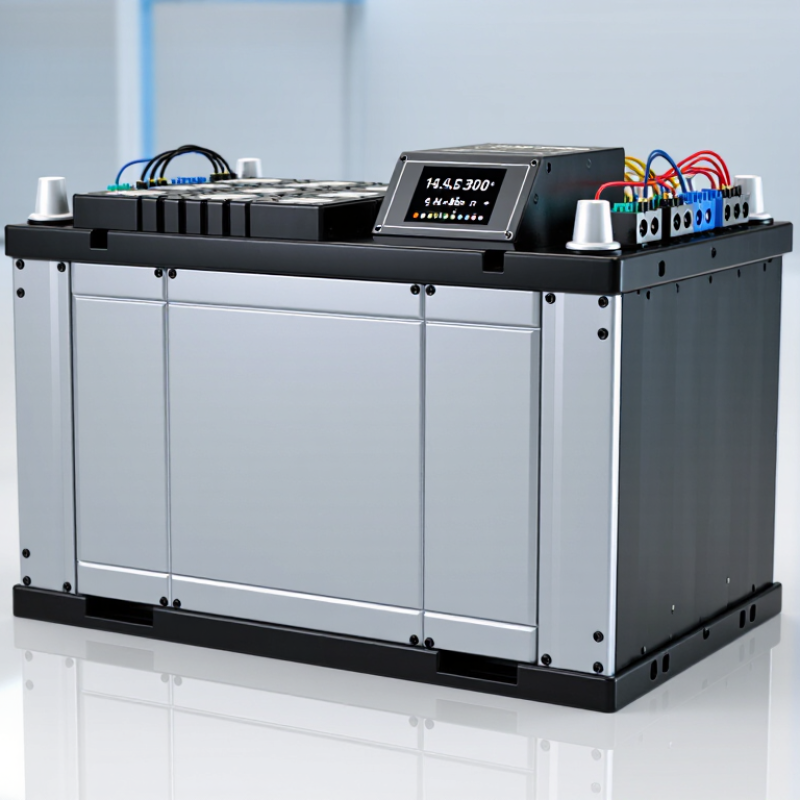
This battery normally contains multiple connected lithium cells, a battery management system, protective fuses, and communication ports. The BMS monitors voltage, temperature, current, and cell balance. It can disconnect the pack during overcharging, deep discharge, or excessive heat. That protection matters more than a large capacity label.
A 48V system suits residential storage, commercial backup, mobile equipment, and renewable-energy projects. Its higher voltage can reduce current compared with low-voltage systems. Smaller cables may be possible, but correct sizing remains essential. A 300Ah battery is not automatically suitable for every inverter. Check continuous current, peak current, charging limits, and communication compatibility.
In practical evaluations, I would inspect the cell chemistry before comparing prices. Lithium iron phosphate cells often offer strong thermal stability and long cycle life. Other lithium chemistries may provide different weight or power advantages. No option is perfect.
Installation quality is easy to underestimate. Poor terminals, weak ventilation, or incorrect settings can shorten service life. Global buyers should request test reports, transport documents, warranty terms, and clear operating limits. The label may say 48V, but the actual voltage range must match the complete system.
| Evaluation Dimension | Typical Specification or Calculation | What Global Buyers Should Check |
|---|---|---|
| Core Electrical Specifications | ||
| Battery chemistry | Lithium-ion; lithium iron phosphate (LiFePO4) is a common option for stationary storage, backup power, and low-speed electric vehicles. | Confirm the exact cathode chemistry because voltage range, thermal behavior, cycle life, and charging requirements differ between lithium-ion chemistries. |
| Nominal voltage | 48 V nominal. A LiFePO4 pack is commonly configured as 16 series cells, with approximately 51.2 V nominal voltage. | The battery must match the inverter, charger, motor controller, or DC system voltage range. “48 V” is a system class rather than one fixed operating voltage. |
| Rated capacity | 300 Ah at the manufacturer-specified test conditions. | Check the test temperature, discharge current, end-of-discharge voltage, and whether the capacity is guaranteed or typical. |
| Nominal energy | Approximately 14.4 kWh using 48 V × 300 Ah. For a 51.2 V LiFePO4 pack, the nominal energy is approximately 15.36 kWh. | Usable energy is lower than nominal energy because of the permitted depth of discharge, inverter losses, temperature, aging, and BMS protection limits. |
| Practical usable energy | About 11.5–13.8 kWh at an 80–90% usable depth of discharge, before inverter losses. | Use the supplier’s tested usable-energy figure when sizing backup duration or an off-grid solar system. |
| Energy at a 1C discharge rate | A 300 Ah battery can theoretically deliver 300 A for approximately one hour, subject to the BMS, temperature, and voltage limits. | The actual continuous current rating may be lower than 1C. Do not select a battery based only on its amp-hour capacity. |
| Performance and Operating Range | ||
| Recommended continuous charge current | Commonly 0.2C–0.5C, equivalent to approximately 60–150 A for a 300 Ah battery, when permitted by the battery specification. | The charger output must remain within the battery’s maximum charge-current limit. Solar charge controllers and AC chargers should be configured separately. |
| Recommended continuous discharge current | Often 0.5C–1C, equivalent to approximately 150–300 A, depending on cell selection, busbars, cables, and BMS rating. | Verify both continuous and peak current ratings. High-current loads may require multiple battery modules connected in parallel. |
| Peak discharge capability | Application-specific; commonly limited to a short duration such as a few seconds to several seconds. | Request the exact peak current, duration, recovery time, and minimum temperature. Motor starting and inverter surge loads can exceed continuous ratings. |
| Charging voltage | For a typical 16-series LiFePO4 pack, the full-charge voltage is commonly around 56–58.4 V, subject to the manufacturer’s setting. | Use a charger specifically matched to the battery chemistry and series-cell configuration. Incorrect voltage can reduce service life or trigger protection. |
| Operating temperature | Typical ranges are approximately −20°C to 55°C for discharge and 0°C to 45°C for charging, but limits vary by design. | Charging below 0°C may require low-temperature cut-off or internal heating. Confirm derating requirements for hot or cold climates. |
| Cycle life | LiFePO4 products may provide several thousand cycles under controlled conditions, often specified at a defined depth of discharge and temperature. | Compare cycle-life test conditions, end-of-life capacity percentage, charge/discharge rate, and warranty conditions rather than comparing cycle counts alone. |
| Safety, Integration, and Reliability | ||
| Battery management system | A suitable BMS should monitor cell voltage, pack voltage, current, and temperature, and provide overcharge, over-discharge, over-current, and short-circuit protection. | Check balancing method, balancing current, low-temperature charge protection, fault recovery, and whether the BMS supports parallel communication. |
| Communication interfaces | Common options include CAN bus, RS485, RS232, Bluetooth, or dry-contact alarms. | Confirm compatibility with the selected inverter or energy-management system, including protocol, baud rate, cable pinout, and firmware requirements. |
| Enclosure and installation | Rack-mount, floor-standing, wall-mounted, or custom enclosure designs are available. Physical dimensions and mass vary significantly. | Request a dimensional drawing, mounting points, cable-access locations, ventilation requirements, lifting method, and minimum service clearance before ordering. |
| Protection rating | Indoor and outdoor versions may use different enclosure ratings; IP ratings must be confirmed for the specific model. | An enclosure’s IP rating does not automatically guarantee resistance to flooding, salt spray, condensation, or direct sunlight. Match protection to the installation site. |
| Safety documentation | For international transport, lithium batteries commonly require UN 38.3 testing documentation and appropriate transport paperwork. | Ask for current test summaries, safety data, packing instructions, and destination-market requirements before shipment. |
| Relevant standards and certifications | Depending on the application and destination, buyers may need evidence of standards for battery safety, EMC, transport, and grid-connected equipment. | Certification requirements vary by country and use case. Confirm whether documentation applies to the complete battery system, not only individual cells. |
| Sizing and Commercial Selection | ||
| Approximate backup duration | At a 1 kW load, 14.4 kWh nominal energy corresponds to about 14.4 hours before practical losses and reserve limits. At a 5 kW load, it corresponds to about 2.9 hours nominally. | Actual runtime depends on usable depth of discharge, inverter efficiency, load profile, ambient temperature, and battery age. |
| Parallel expansion | Multiple 48 V batteries may be connected in parallel when the BMS, cables, fuses, inverter, and manufacturer instructions support it. | Verify maximum parallel quantity, module matching rules, equal cable lengths, pre-charge requirements, and communication architecture. |
| Weight and shipping | A 48 V 300 Ah lithium battery commonly weighs several hundred kilograms at system level, depending on chemistry, enclosure, cooling, and accessories. | Obtain the verified gross weight, net weight, pallet dimensions, dangerous-goods classification, and shipping method before calculating landed cost. |
| Total cost of ownership | Evaluate purchase price together with usable kWh, expected cycle life, efficiency, warranty, replacement parts, freight, duties, installation, and recycling arrangements. | A lower initial price may not provide the lowest cost per delivered kWh over the battery’s service life. |
| Best-fit applications | Residential and commercial energy storage, solar-plus-storage systems, telecom backup, mobile power, marine systems, and selected low-speed electric vehicles. | Confirm that the battery’s voltage, current, environmental rating, communication protocol, and certification package fit the intended application. |
Note: The figures above are typical engineering reference values for a 48 V-class, 300 Ah lithium battery. Final specifications must be confirmed in the official datasheet for the selected battery configuration and application.